
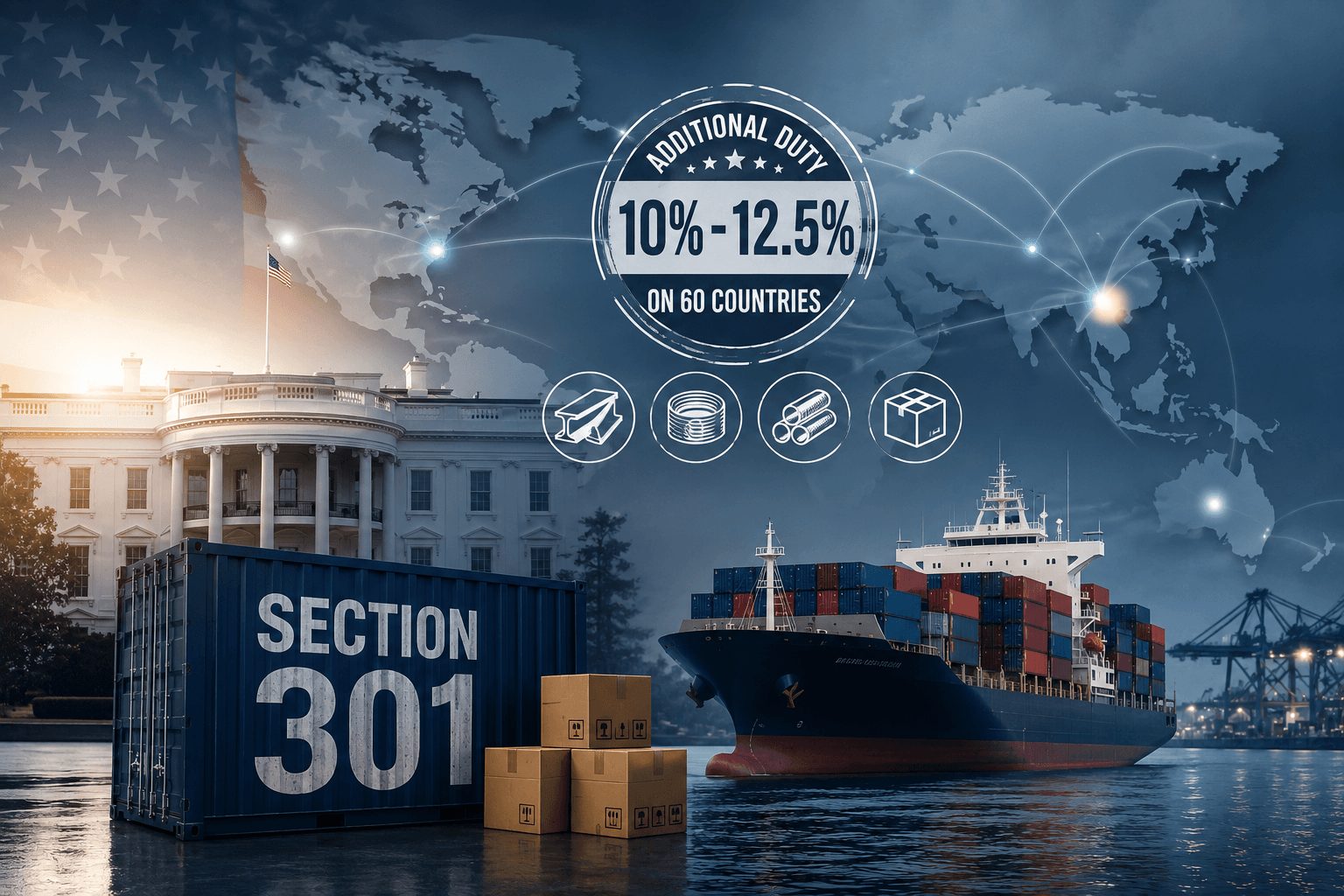
The US Section 301 tariff took effect on July 24, 2026, adding a 12.5% duty on Turkish goods. Here's the scope, exemptions, and what it means for your business.
The Office of the United States Trade Representative (USTR) issued its final determination in the Section 301 forced labor investigation covering 60 economies, which took effect at 00:01 ET on July 24, 2026. Turkey is among the 60 economies now subject to a new duty of 10 to 12.5 percent, in addition to existing customs duties. This action replaces the temporary 10 percent global Section 122 tariff, which expired the same day.
Section 122's Expiration and Section 301's Entry into Force
Following the Supreme Court's February 2026 ruling that tariffs imposed under IEEPA were unlawful, the Trump administration rebuilt its tariff framework in two stages. First, on January 24, 2026, a temporary 10 percent global tariff took effect under Section 122, though that mechanism was legally capped at 150 days and a maximum rate of 15 percent. Second, USTR launched a forced labor investigation covering 60 economies in March 2026; that investigation reached its final determination and took effect on July 24, 2026, precisely as Section 122 expired.
The 12.5% Rate Applied to Turkey
USTR classified the 60 economies under review based on their performance in preventing imports made with forced labor. Economies that adopted partial measures or made commitments, including Canada, Ecuador, the European Union, Indonesia, Mexico, Pakistan, the United Kingdom, Taiwan, and several Central American countries, were assigned the 10 percent rate. Turkey, along with China, Brazil, Vietnam, Russia, and 38 economies in total, was assigned the full 12.5 percent rate for insufficiently enforcing and monitoring forced labor import bans. This rate applies to Turkish-origin goods entering the United States on top of existing customs duties.
Section 232 Products and Other Exemptions
Although the new Section 301 duty is broad in scope, it includes significant carve-outs. Products already subject to Section 232 sectoral tariffs, such as steel, aluminum, copper, pharmaceuticals, timber products, passenger vehicles, and trucks, are exempt from this new 12.5 percent duty to avoid double taxation. Also exempt are Canadian and Mexican goods entering duty-free under USMCA, textile products under CAFTA-DR, humanitarian donations, and informational materials. The universal exemption list in Annex II of the executive order covers raw materials not sufficiently produced in the US, goods that could cause economic disruption, products unavailable domestically or from alternative sources, and items deemed unlikely to advance the tariff's policy goals. Of the 2,120 items on that list, only 863 are exempt on direct entry; the rest are limited to civil aviation or pharmaceutical use.
Transition Period and Compliance
Cargo already loaded onto its final mode of transport before July 24 and already in transit is exempt from the new duty, provided it clears customs by July 28, 2026. USTR has not established a product-specific exclusion process at this stage; any future changes will be addressed through the general review process under Section 307 of the Trade Act rather than individual applications. This makes it critical for businesses to clarify their HTS classifications and exemption eligibility now.
Manage Your US Customs Operations with Dexpell Logistics
At Dexpell Logistics, we closely track evolving tariff regulations affecting exports and imports to the United States, offering end-to-end support on HTS classification, customs clearance, and Section 232 / Section 301 exemption analysis. We provide regular ocean and air freight services from Istanbul, Izmir, and Mersin to ports on both the US East and West Coasts.
Get a quote for US customs and tariff consulting now: https://www.dexpell.com/en/quote — protect your business against the new Section 301 regulations with Dexpell's expertise.

By
Ersin TurgutVice President — US Customs & Trade
Ersin Turgut is Vice President at Dexpell Logistics, working across U.S. customs regulations, import processes, international logistics and foreign-trade compliance. In his articles he interprets current developments in U.S. trade in a clear, actionable way.
Dexpell is here for your logistics needs
Sea, air, and road freight, project logistics, and trade consulting across 90+ countries.
