
For importers moving cargo from China to Syria: sea, rail and road transit options via Turkey, current port conditions, customs process and the factors that determine freight cost.
Last Updated: August 28, 2026. Port, customs and sanctions conditions in Syria can change quickly — please confirm current status with Dexpell before shipping.
How to Ship Cargo from China to Syria
Direct sailings from China to Syria remain limited, so most cargo moves through a regional transshipment hub — Port Said, Mersin, Piraeus or Jebel Ali — before being transferred to Latakia or Tartous on feeder vessels. Growing China-Turkey rail links (the Middle Corridor) and Turkey's land border with Syria make Turkey a practical transit and consolidation point for China-origin cargo. Dexpell uses its operational base in Turkey to consolidate containers and part-loads arriving from China at Mersin or Iskenderun, then forwards them to Syria by sea or road.
Why Route via Turkey?
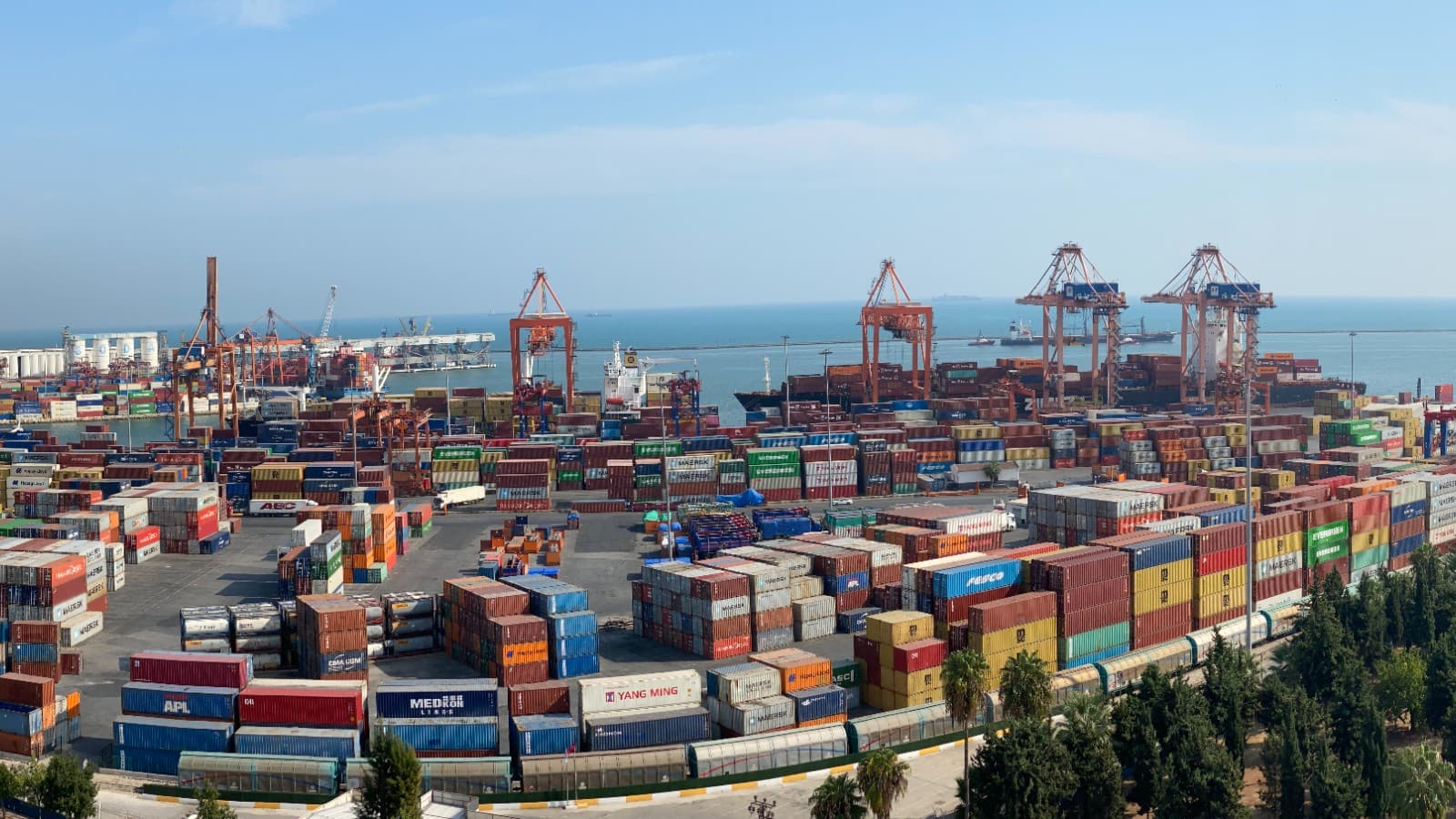
Because only a limited number of carriers offer direct regular service to Syria, most cargo is first discharged at a major regional port and transshipped from there. The Port of Mersin, Turkey's largest container port, is served by more than 20 regular shipping lines connecting to major ports worldwide, including China. From Mersin, cargo bound for Syria can continue by feeder vessel or by road across the land border. This model lets cargo move on the more frequent China-Turkey services rather than waiting for a single direct China-Syria sailing, with a reliable operator in Turkey handling the final leg.
Transport Methods: Sea, Rail and Combined Solutions
Ocean Freight with Transshipment
Container vessels from major Chinese ports (Shanghai, Ningbo, Shenzhen, Qingdao) call at Mersin or Iskenderun; from there, cargo is either transshipped by feeder to Latakia/Tartous or moved overland across the border into Syria. Both FCL and LCL options are available depending on cargo volume.
Rail: The Middle Corridor Connection
The China-Turkey Middle Corridor rail route strengthened notably in 2026, with new cooperation agreements between Turkish and Chinese rail operators and shorter transit times following capacity upgrades on the Baku-Tbilisi-Kars line. The first return freight service from Izmir to China in May 2026 confirmed the route can carry commercial cargo in both directions. Cargo arriving in Turkey by rail can then be forwarded to Syria by road or a short sea hop.
Road Connection and Border Crossing Note
A regulation Syria introduced in February 2026 restricts foreign-registered trucks from entering the country directly, meaning cargo must be transferred to Syrian-registered vehicles at the border. This adds an extra handling step and time to road-connected shipments routed through Turkey. Dexpell tracks current border procedures and organizes this transfer step accordingly.
Current Port Situation in Syria
Latakia and Tartous ports together received close to 945 vessels in the first half of 2026, handling roughly 8 million metric tons of cargo. Tartous alone handled 551 vessels and around 5 million tons (3.9 million tons of imports, 1.1 million tons of exports), while Latakia continues to handle the larger share of container traffic. Both ports are undergoing crane and equipment modernization to raise handling capacity, and container handling fees were adjusted as of February 1, 2026. In August 2026, management of a commercial berth at Tartous previously under Russian control was transferred to the Syrian side. Conditions and procedures at both ports remain subject to change, so confirming current status before each shipment is advisable.
On sanctions: the US lifted most Syria-related sanctions starting July 2025 and rescinded Syria's state sponsor of terrorism designation in August 2026, though restrictions remain on individuals and entities tied to the former regime, as well as on arms, dual-use technology, precious metals and luxury goods. The EU lifted most sectoral sanctions in May 2025 but extended listings on former-regime-linked individuals and entities through June 2026, and its arms embargo remains in place. Because of this, the classification of the goods being shipped and their end destination should always be checked before booking.
Shipping Cost: What Determines the Price
China-Syria freight cost depends on cargo type, chargeable weight versus volume, whether the shipment moves FCL or LCL, the transshipment port chosen (Mersin, Iskenderun, Port Said, Piraeus or Jebel Ali), the Incoterm used (FOB, CIF, DDP, etc.), fuel and security surcharges, port handling fees, and the cost of the border transfer step. Rates on this corridor can shift week to week, so a current quote is more reliable than a fixed estimate.
Transit Time
Sea transit from China to Turkish ports varies by port of origin and service type and can take several weeks; the Middle Corridor rail route via Baku-Tbilisi-Kars has become faster following recent capacity upgrades. The final leg from Turkey to Syria depends on the method chosen — feeder sea service or road with a border transfer — and on current border processing times. Rather than quoting a fixed day count, we recommend requesting a quote for an accurate delivery timeline based on current routing and border conditions.
Required Documents & Customs Clearance
Shipments typically require a commercial invoice, packing list, certificate of origin, and a bill of lading (or air waybill for air shipments), plus any product-specific certificates. Because Syrian customs rules and sanctions lists are still evolving, the HS code and classification of the goods should be confirmed before shipping — categories such as arms, dual-use technology, precious metals and luxury goods remain restricted.
Dexpell's Operational Support
Dexpell provides end-to-end support for China-to-Syria shipments: cargo pickup from the supplier/factory in China, consolidation at Mersin or Iskenderun, organizing the final leg by feeder sea service or road, preparing the required export/import documentation, and tracking current border and customs procedures. With its operational base in Turkey, Dexpell can route China-origin cargo to Syria through a flexible, multi-point path rather than waiting on a single direct sailing.
Get a China-to-Syria Shipping Quote
Send us your cargo type, weight, volume, origin (city/port in China), destination (Latakia, Tartous, Damascus, Aleppo, etc.) and preferred Incoterm for a current freight and routing recommendation: https://www.dexpell.com/en/quote
For Syria shipment requests, you can also email us directly at info@dexpell.com.
Frequently Asked Questions
Is there a direct ship service from China to Syria?
Direct regular service is limited; cargo is usually transshipped via Mersin, Port Said, Piraeus or Jebel Ali to Latakia or Tartous by feeder vessel.
What's the advantage of routing via Turkey?
Turkey has both sea and rail (Middle Corridor) connections to China and a direct land border with Syria, giving more frequent sailing options and flexible routing.
Can cargo move to Syria by rail?
The China-Turkey Middle Corridor rail route is actively used; cargo reaching Turkey by rail can then be forwarded to Syria by road or sea.
Are Syrian ports currently operating?
Yes, Latakia and Tartous are operational and handled hundreds of vessels in the first half of 2026, though capacity and procedures can change, so current confirmation is recommended.
Why is a truck transfer needed at the border?
Syria's February 2026 regulation restricts foreign-registered trucks from entering directly, so cargo is transferred to Syrian-registered vehicles at the crossing.
How much does freight cost?
Cost depends on cargo type, weight/volume, transshipment routing and Incoterm; request a current quote for accurate pricing.
What documents are required?
A commercial invoice, packing list, certificate of origin and bill of lading/AWB are standard; additional certificates may apply depending on the product.
Do sanctions affect China-Syria trade?
Most US and EU sanctions were eased in 2025-2026, but restrictions remain on certain individuals, entities and product categories (arms, dual-use technology, luxury goods); product-level confirmation is recommended.
What services does Dexpell provide?
Dexpell offers end-to-end support: cargo pickup in China, consolidation at Mersin/Iskenderun, final-leg sea or road organization, and documentation preparation.
Can shipments be delivered specifically to Damascus or Aleppo?
Yes, cargo transshipped via Turkey can be routed to different regions of Syria including Damascus and Aleppo — see our dedicated city guides for more detail.
Related Services & Articles
https://www.dexpell.com/tr/media/blog/suriye-karayolu-tasimaciligi-2026
https://www.dexpell.com/tr/media/blog/avrupadan-suriyeye-tasima
https://www.dexpell.com/tr/media/blog/sam-a-karayolu-denizyolu-havayolu-tasimaciligi
https://www.dexpell.com/tr/media/blog/halep-e-lojistik-cozumleri
https://www.dexpell.com/tr/media/blog/cin-lojistik-firmasi
https://www.dexpell.com/tr/media/blog/cin-den-ithalat
https://www.dexpell.com/tr/media/blog/cin-ddp-tasima
https://www.dexpell.com/tr/media/blog/cin-denizyolu-navlun-fiyatlari
Sources: Syrian port statistics (SANA, TASS, H1 2026 data), US and EU sanctions updates (WilmerHale, White & Case, Sidley Austin, Consilium), Middle Corridor rail developments (Jamestown Foundation, Daily Sabah, Ports Europe), Port of Mersin capacity data (MIP/AIVP). Research current as of August 28, 2026 — please reconfirm before shipping.
Photo: Port of Mersin — SeyfettinGündoğdu, CC BY-SA 4.0, Wikimedia Commons.

By
Dexpell LogisticsInternational Logistics & Trade
Dexpell Logistics is an international freight forwarding company offering sea, air and road transport, project logistics and trade consulting across 90+ countries. The news, guides and analyses on this blog are produced by the Dexpell expert team.
Dexpell is here for your logistics needs
Sea, air, and road freight, project logistics, and trade consulting across 90+ countries.
