
Shipping from Turkey to Mali via Dakar and Abidjan to Bamako: container and air freight options, BESC, import taxes, a worked cost example and how to get a quote.
Last updated: 15 November 2026
How do you ship from Turkey to Mali?
Shipping from Turkey to Mali is fully possible, but because Mali is landlocked, your container first sails to a West African seaport (usually Dakar or Abidjan) and then travels more than 1,000 km by road to Bamako. Urgent and lighter cargo can fly into Bamako Modibo Keïta (Sénou) International Airport. Your freight cost is driven by container type, the corridor you choose, the inland trucking leg, Mali's import taxes and the BESC cargo tracking note, which Mali has been enforcing strictly for sea cargo in 2026. This guide explains how the price is built, walks through a worked cost example, covers transit-time logic and lists exactly what to prepare for a quote.
Not sure which corridor or mode suits your cargo? Describe your product and dimensions in Dexpell.ai Chat and we will narrow down the right Mali option with you.
What are the shipping options from Turkey to Mali?
Sea + road: FCL container shipping
For commercial volumes, the standard solution is a 20ft or 40ft container from a Turkish port (Istanbul-area ports, Izmir/Aliağa or Mersin) to Dakar or Abidjan, followed by transit trucking to Bamako. Whether the cargo is transloaded at the port or the loaded container is hauled all the way to Bamako depends on the carrier's container return terms and the inland cost.
LCL (less than container load)
Exporters who cannot fill a container can consolidate LCL cargo to a West African port, where it is deconsolidated and moved to Bamako by groupage truck. LCL is charged per CBM or weight/measure (W/M), but for Mali the inland leg and transit paperwork make up a large share of the cost on small shipments.
Air freight and courier
Spare parts, samples, electronics and urgent commercial goods can be flown from Istanbul to Bamako on connecting or multi-stop services. Because the schedule structure (direct, multi-stop or connecting) changes with the timetable, it is confirmed at booking. For documents and small parcels, our Courier & Express service may be the more practical choice.
Project and heavy cargo
Mining, energy, construction and agricultural equipment that is out of gauge moves on flat rack or open top containers or as breakbulk to the port, then onward on permitted heavy-haul trucks into Mali. Route surveys and permits are the most critical part of planning for these loads.
Dakar or Abidjan? Choosing a corridor to Mali
Dakar (Senegal): Historically one of Mali's most important gateways. According to an analysis published by Financial Afrik in October 2026, freight to Mali now largely uses the southern Kédougou–Moussala border crossing instead of the Kidira–Kayes axis, and a truck queue several tens of kilometres long was reported there on 1 October. Border waiting time must therefore be built into any Dakar plan. For port details see our Turkey to Senegal shipping guide.
Abidjan (Côte d'Ivoire): According to the same source, Abidjan moved about 1.47 million tonnes to Mali in 2025, making it one of Mali's two main entry points alongside Dakar. From Abidjan, cargo runs north via Sikasso to Bamako.
Alternative gateways: Conakry (Guinea), Lomé (Togo) and Tema (Ghana) are evaluated case by case. Related guides: Guinea, Togo, Ghana.
Operational note: security conditions on some inland corridors into Mali have meant that, through 2025–2026, fuel tankers in particular have been reported moving in escorted convoys. For general cargo, the corridor should be chosen based on conditions at the shipping date; Dexpell makes this assessment at quotation stage.
What determines Turkey to Mali freight cost?
Ocean leg: Container type (20'DC, 40'DC, 40'HC), origin port, discharge port (Dakar, Abidjan or an alternative), carrier and transshipment hub, bunker and seasonal surcharges, destination THC and delivery order fees.
Inland leg: Port-to-Bamako distance, whether the loaded container is hauled or cargo is transloaded, transit bond and transit document fees, border waiting time, empty container return and, where needed, convoy arrangements.
Air leg: Chargeable weight (the greater of actual and volumetric weight), cargo type (general, dangerous goods, valuables), fuel and security surcharges, and Bamako airport handling.
At destination: Import duty, statistical fee, community levies, VAT, licensed customs broker fees, the BESC fee and final delivery.
Incoterm: EXW, FCA, FOB, CFR/CIF, DAP or DDP decides who pays which cost. For a long-inland-leg country like Mali, the gap between CIF Dakar/Abidjan and DAP Bamako is often larger than shippers expect.
Market averages (market average, not a Dexpell price): In air freight, WorldACD data for the week of 5–11 October 2026 put the global full-market average at USD 3.13 per kg and the global spot average at USD 3.55 per kg, with spot rates out of Africa up about 10% week on week. These are global averages across all lanes, not an Istanbul–Bamako rate. For the sea + road combination, we found no reliable, sourced container average for Turkey–Mali (or Turkey–Dakar/Abidjan), so we do not publish a figure. The actual price is set at quotation stage based on corridor, date and cargo details.
Worked Cost Simulation
1) Chargeable weight
Air freight example (divisor 6000): Two pallets of textiles, each 120 × 100 × 120 cm and 150 kg. Total actual weight is 300 kg. Volumetric weight: 120 × 100 × 120 / 6000 = 240 kg per pallet, 480 kg in total. Since volumetric weight is higher, the chargeable weight is 480 kg. With light but bulky goods like this, lowering or compressing pallets cuts cost directly.
Courier/express example (divisor 5000): A sample carton measuring 50 × 40 × 40 cm and weighing 8 kg. Volumetric weight: 50 × 40 × 40 / 5000 = 16 kg, so the chargeable weight is 16 kg. Dexpell has no published per-kg courier rate for non-European lanes, so only the calculation method is shown here.
2) Mali landed-cost (duty and tax) example
Assumption: a commercial shipment with a customs value of USD 26,000, including transport and insurance up to the Malian border. This is an illustrative calculation; the real amount depends on the HS code, origin documentation and Mali Customs' valuation.
Scenario A – finished consumer goods (e.g. furniture, 20% duty band): Import duty 20% = USD 5,200; statistical fee (RS) 1% = USD 260; UEMOA community solidarity levy (PCS) 1% = USD 260; AES confederal levy 0.5% = USD 130; AfCFTA levy 0.2% = USD 52. VAT base USD 31,902, VAT 18% = USD 5,742.36. Total duties and taxes about USD 11,644; landed value about USD 37,644.
Scenario B – capital goods/machinery (5% band): Import duty USD 1,300; RS, PCS, AES and AfCFTA levies USD 702 in total; VAT base USD 28,002, VAT 18% = USD 5,040.36. Total duties and taxes about USD 7,042.
Basis for the rates: Mali applies the UEMOA common external tariff bands; according to the WTO's 2025 tariff profile, Mali's highest applied rate is 35% and its simple average is 12%. The AES states (Mali, Burkina Faso, Niger) introduced a 0.5% confederal levy on imports from outside the bloc in March 2025; the U.S. Commerce Department's Mali guide states that this replaced the ECOWAS community levy and that a 0.2% AfCFTA levy applies to non-African Union countries. The standard VAT rate is 18%. This example excludes the cyclical import tax (TCI), excise and product-specific charges; a customs broker should confirm the final calculation.
Want to see this calculation with your own product, HS code and value? Enter your dimensions, weight and invoice value in Dexpell.ai Chat and we will run the freight and landed-cost simulation with your real numbers.
How long does shipping from Turkey to Mali take?
Total time to Mali has three parts: ocean transit from Turkey to Dakar or Abidjan (depending on whether the service is direct or transships in the Mediterranean), port discharge and transit customs formalities, and the road leg to Bamako. Border queues and security-related convoy arrangements on the inland leg can create more variability than the sea leg itself. Rather than promising a fixed number of days, we build a door-to-door plan from the carrier schedule and corridor conditions at your shipping date.
For air freight, timing depends on whether the flight is direct, multi-stop or connecting, the dwell time at the transfer point and customs processing in Bamako.
Mali's main trade gateways and delivery points
Bamako is the country's commercial and distribution hub, where most imports are cleared and distributed. Kayes in the west, Sikasso in the south and Ségou on the Niger River are other key trading cities. Bamako Modibo Keïta (Sénou) International Airport (BKO) is the main air cargo gateway. For sea freight, the practical gateways are neighbouring countries' ports: mainly Dakar and Abidjan, plus Conakry, Lomé and Tema.
What products are shipped from Turkey to Mali?
Turkey's exports to Mali include textiles and apparel, home textiles and blankets, furniture and seating, wood and joinery products, iron and steel tanks and construction materials, vehicles and spare parts, and electrical equipment. Because these products fall into different duty bands, correct HS classification of every line in a mixed container directly affects the tax bill.
Shipping machinery from Turkey to Mali
Agricultural machinery, food processing lines, generators and construction equipment usually move in 40'HC, flat rack or open top containers. Heavy and out-of-gauge pieces need specialised trucks and a route plan from the port to Bamako.
Exporting textiles and furniture from Turkey to Mali
For bulky but relatively light goods, making full use of a 40'HC lowers the unit cost. Furniture needs robust packing against humidity and a long road leg, and textiles clear faster with an accurate packing list.
Required documents and customs clearance
Core documents for Turkey–Mali shipments are the commercial invoice, packing list, bill of lading (B/L) for sea or air waybill (AWB) for air, Turkish export declaration and certificate of origin. Depending on the product, health, phytosanitary or conformity certificates may be required.
BESC (Bordereau Électronique de Suivi des Cargaisons): Sea cargo with a final destination in Mali needs a BESC even when it is discharged at Dakar, Abidjan, Conakry or Lomé. It is issued by the Conseil Malien des Chargeurs (CMC) and must be validated before the vessel reaches the port of discharge. According to reports on CMC circular of 13 April 2026, declarations without a properly issued BESC are refused at Mali's border customs offices and sent back to the port for regularisation. Requirements for air and road cargo should be confirmed separately before shipping.
Customs clearance in Mali is handled through licensed customs brokers with the Direction Générale des Douanes du Mali. In the transit country (Senegal or Côte d'Ivoire), transit declarations and bonds are also required.
What does Dexpell do on the Turkey–Mali lane?
Dexpell manages pickup from your factory or warehouse in Turkey, export customs, FCL and LCL ocean bookings, air freight bookings as an IATA cargo agent, document coordination so the BESC is completed on time, the transit agent at the discharge port, trucking to Bamako, coordination with the customs broker in Mali, and door delivery, all in one file. Cargo insurance, project cargo planning and shipment tracking are available on request. In your quote, we indicate which corridor is the better fit at that date, taking port and border conditions into account.
Get your Turkey to Mali freight quote
Calculate your current Mali freight and door-to-door cost now. In Dexpell.ai Chat, simply share: pickup city in Turkey, delivery city in Mali (Bamako, Kayes, Sikasso, etc.), product description and HS code if known, number of cartons or pallets, dimensions, gross weight, container type (for FCL), invoice value, preferred Incoterm and cargo-ready date. If you prefer the classic quote form: https://www.dexpell.com/en/quote
Prefer email? You can also send your shipment request directly to info@dexpell.com.
Frequently Asked Questions
How much does shipping from Turkey to Mali cost?
The price depends on container type, discharge port (Dakar or Abidjan), the inland leg to Bamako, cargo type and Incoterm. There is no reliable published container average for Turkey–Mali, so you need a current quote for an exact figure.
Which port is used for containers to Mali?
As Mali is landlocked, containers usually go to Dakar (Senegal) or Abidjan (Côte d'Ivoire) and continue to Bamako by road. Conakry, Lomé and Tema are alternative gateways.
How long does sea freight from Turkey to Mali take?
Transit time is the sum of the ocean leg, port and transit customs formalities and the road leg. Border queues and convoy arrangements on the inland leg can change the total, so planning is done for your specific shipping date.
What is the BESC and is it needed for every shipment to Mali?
The BESC is the electronic cargo tracking note issued by the Conseil Malien des Chargeurs and is required for sea cargo with a final destination in Mali. It must be validated before the vessel reaches the discharge port; requirements for air and road shipments should be confirmed separately.
What import taxes apply in Mali?
Import duty by product band (from 0% up to 35% under the applied tariff), a 1% statistical fee, 1% PCS, the 0.5% AES confederal levy, a 0.2% AfCFTA levy for non-African Union origin, and 18% VAT. Product-specific taxes may also apply.
Can I send air cargo from Istanbul to Bamako?
Yes. Air freight is planned on multi-stop or connecting services into Bamako Modibo Keïta Airport. It is charged on the greater of actual and volumetric weight.
Does Dexpell deliver to the door in Mali?
Yes. Dexpell can plan trucking and customs broker coordination from the port or airport to your delivery address in Bamako and other cities. Delivery terms (DAP or DDP) are stated in the quote.
Can I ship LCL cargo to Mali?
Yes. LCL is consolidated to a West African port and moved to Bamako by groupage truck. On small volumes, inland and documentation costs weigh heavily, so it is worth comparing with air freight.
Related Services and Articles
https://www.dexpell.com/en/media/blog/shipping-from-turkey-to-senegal
https://www.dexpell.com/en/media/blog/shipping-from-turkey-to-guinea
https://www.dexpell.com/en/media/blog/shipping-from-turkey-to-togo
https://www.dexpell.com/en/media/blog/shipping-from-turkey-to-ghana
https://www.dexpell.com/tr/services/courier-express
Sources: WTO tariff profile for Mali (2025 data); U.S. Department of Commerce, Mali Country Commercial Guide – Import Tariffs; Ecofin Agency (AES 0.5% confederal levy, March 2025); TaxAtlas Mali VAT rates 2026; WorldACD Weekly Air Cargo Trends 2026 week 41 (19 October 2026); Financial Afrik, Dakar–Bamako corridor analysis (15 October 2026); GetCTN Mali BESC guide (CMC circular, accessed 15 October 2026). Rates and corridor conditions can change and should be confirmed before shipping.
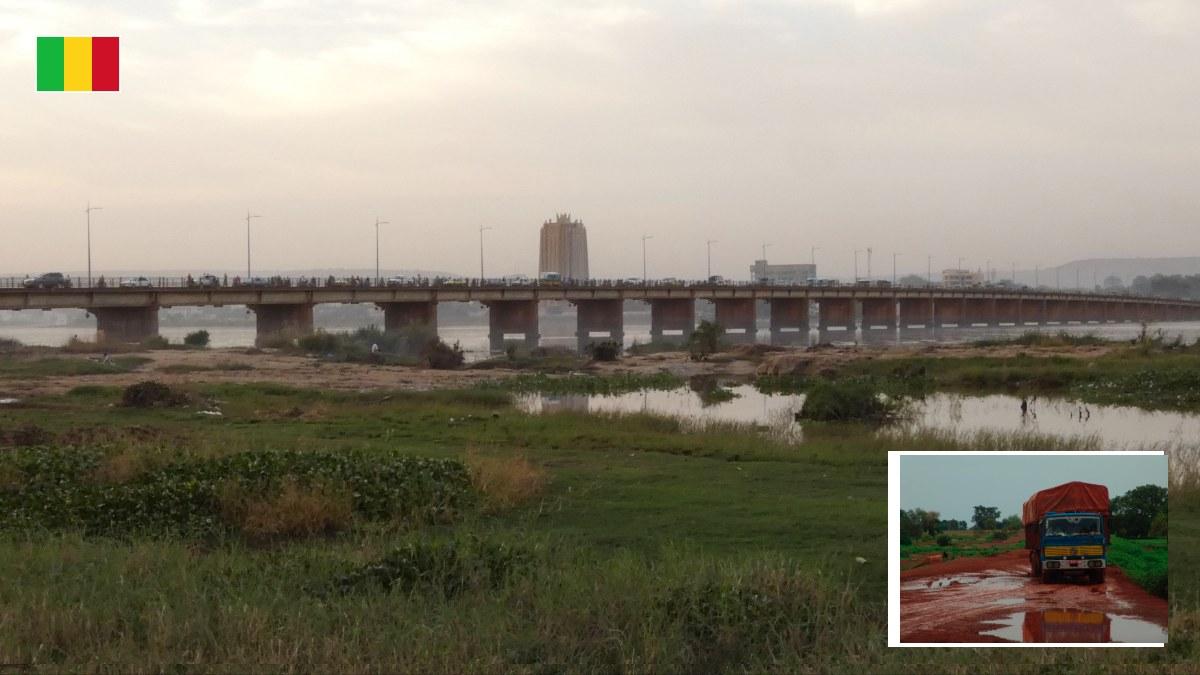
Image: "Pont des Martyrs Bamako" by Gregor Rom, CC BY-SA 4.0, via Wikimedia Commons; inset: truck on the Kayes–Dakar road, NOAA, public domain. Cropped and combined by Dexpell.

By
Dexpell LogisticsInternational Logistics & Trade
Dexpell Logistics is an international freight forwarding company offering sea, air and road transport, project logistics and trade consulting across 90+ countries. The news, guides and analyses on this blog are produced by the Dexpell expert team.
Dexpell is here for your logistics needs
Sea, air, and road freight, project logistics, and trade consulting across 90+ countries.
