
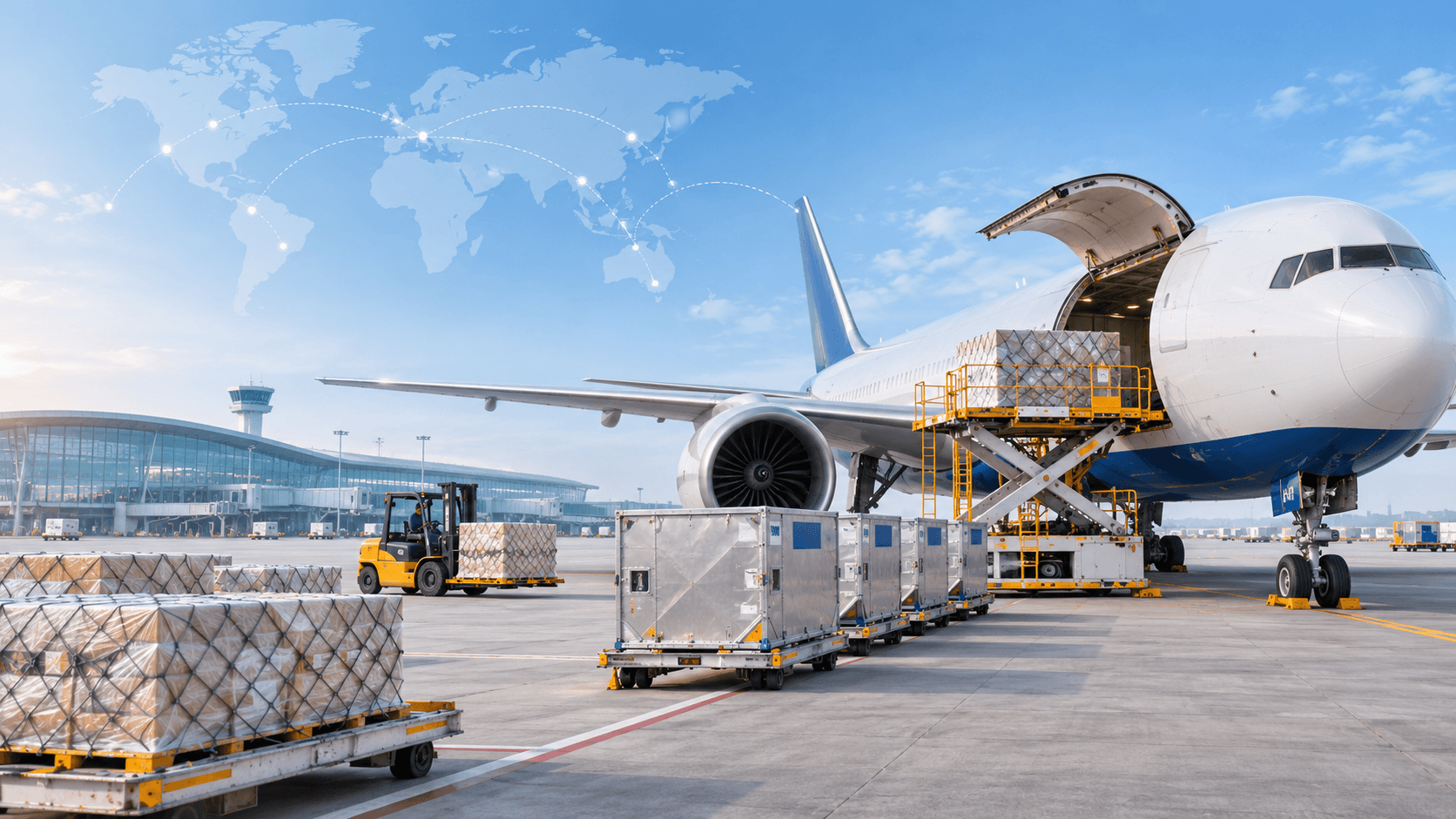
In international trade, fast, secure, and reliable delivery plays an essential role in maintaining efficient supply chains.
In international trade, fast, secure, and reliable delivery plays an essential role in maintaining efficient supply chains. For businesses handling time-sensitive shipments, air freight transportation offers one of the fastest ways to move goods across international borders.
But what is air freight, how does it work, and what are its main advantages? In this guide, we explain the fundamentals of air logistics, the international air cargo shipping process, the factors affecting transportation costs, and the key considerations for successful shipments.
What Is Air Freight Transportation?
Air freight transportation is the movement of commercial goods, raw materials, or specialized cargo from one location to another using dedicated cargo aircraft or the cargo compartments of passenger aircraft.
Widely used in international trade, air freight provides shorter transit times than many other transportation methods, particularly for long-distance shipments.
It is an effective solution for businesses that need to transport urgent, high-value, or time-sensitive goods across global markets.
However, air freight shipping involves more than simply loading goods onto an aircraft. It includes cargo collection, packaging, documentation, customs clearance, flight coordination, tracking, and final delivery.
What Is Air Logistics?
Air logistics refers to the coordination and management of all operations involved in transporting goods by air.
It includes freight planning, cargo handling, warehousing, customs procedures, transportation management, and delivery coordination.
The primary objective of efficient air logistics is to ensure that shipments reach their destinations quickly, safely, and in compliance with international transportation regulations.
What Are the Advantages of Air Freight Transportation?
International air freight offers several benefits for businesses that prioritize speed, efficiency, and supply chain reliability.
The main advantages include:
Fast Transit Times: Air transportation significantly reduces shipping times on many international routes.
Global Accessibility: International airport networks connect businesses with markets across different continents.
Efficient Inventory Management: Faster transportation helps businesses respond to urgent stock requirements and reduce supply chain disruptions.
Suitable for High-Value Goods: Air freight is commonly used for electronics, medical equipment, and other valuable products.
Shipment Visibility: Digital tracking systems allow businesses to monitor cargo movements throughout the shipping process.
Supply Chain Flexibility: Urgent components and materials can be transported more quickly to support production schedules.
Although air freight provides significant advantages, transportation capacity, cargo characteristics, and shipping costs should also be considered.
For heavy or oversized shipments, alternative transportation methods may provide greater cost efficiency.
How Does the Air Freight Shipping Process Work?
The air freight process consists of several coordinated stages, from shipment preparation to final delivery.
1. Shipment Planning and Cargo Assessment
The first step involves identifying the type of goods, weight, dimensions, origin, and destination.
Based on this information, freight forwarders evaluate suitable transportation options, estimated shipping costs, and available flight schedules.
2. Air Freight Booking
Once the shipment details are confirmed, an appropriate airline and flight route are selected.
During the booking process, cargo capacity, transit times, connecting flights, and airline restrictions are considered.
3. Packaging and Documentation
Cargo must be packaged according to applicable air transportation requirements.
Commercial invoices, packing lists, and other necessary shipping documents are prepared to support smooth cargo handling and customs procedures.
4. Export Customs Clearance
Before departure, the shipment must complete the applicable export customs procedures.
Depending on the product category and destination country, additional permits, certificates, or regulatory approvals may be required.
5. Air Transportation and Shipment Tracking
Following cargo acceptance and security checks, the goods are loaded onto the aircraft.
Throughout transportation, shipment status can be monitored using airline tracking systems or digital logistics platforms.
6. Import Customs Clearance and Final Delivery
After arrival at the destination airport, the cargo undergoes the necessary import customs procedures.
Depending on the selected service, the shipment can be collected from the airport or delivered directly to the consignee's designated address.
Professional coordination throughout these stages helps minimize delays, unexpected expenses, and operational risks.
What Types of Goods Can Be Transported by Air Freight?
Air cargo transportation supports a wide range of industries, particularly those requiring short delivery times or specialized cargo handling.
Commonly transported products include:
Electronic devices and technological equipment
Automotive spare parts and machinery components
Textile products and seasonal fashion collections
Medical devices and healthcare supplies
Commercial samples and important documents
Perishable food products requiring appropriate handling conditions
High-value commercial goods
Special Cargo and Dangerous Goods Transportation
Certain products require additional precautions during air transportation.
For example, lithium batteries, specific chemicals, and temperature-sensitive products may be subject to special packaging, labeling, documentation, and airline approval requirements.
Therefore, shipments involving restricted or dangerous goods must be evaluated according to applicable IATA Dangerous Goods Regulations (DGR) and airline-specific requirements.
How Are Air Freight Shipping Costs Calculated?
Air freight rates vary depending on shipment characteristics, transportation routes, and the services required.
Unlike fixed-price delivery services, international air cargo pricing is typically determined by several operational factors.
Factors Affecting Air Freight Rates
The main factors influencing air freight costs include:
Actual and volumetric weight of the shipment
Origin and destination airports
Flight distance and number of connections
Cargo type and special handling requirements
Airline capacity and seasonal demand
Customs clearance, cargo handling, and final delivery services
What Is Volumetric Weight in Air Freight?
Air freight pricing considers not only the physical weight of cargo but also the amount of space it occupies.
This is known as volumetric weight, also called dimensional weight.
A commonly used air freight calculation formula is:
Volumetric Weight (kg) = Length (cm) × Width (cm) × Height (cm) / 6000
For example, a package measuring 80 × 60 × 50 cm has a volumetric weight of 40 kg.
If its actual weight is 30 kg, the shipment may be charged based on its 40 kg volumetric weight.
The final chargeable weight depends on the applicable airline tariff and pricing rules.
To estimate the weight used for freight pricing, explore Dexpell's Volume and Chargeable Weight Calculator.
Air Freight vs. Sea Freight: What Are the Differences?
Choosing the right transportation method is essential for balancing delivery speed, shipping costs, and cargo requirements.
ComparisonAir FreightSea FreightTransit TimeGenerally fasterGenerally longerTransportation CostUsually higher per unitMore economical for large shipmentsCargo CapacityLimited by aircraft capacitySuitable for heavy and bulky cargoBest ApplicationUrgent and time-sensitive shipmentsHigh-volume and planned shipments
Air freight is generally preferred for urgent deliveries, while sea freight transportation may be a more economical solution for larger and heavier shipments.
The most suitable transportation method should be selected based on cargo characteristics, delivery deadlines, total logistics costs, and business requirements.
What Documents Are Required for International Air Freight?
International air cargo shipments require specific documentation to comply with transportation and customs regulations.
The exact requirements depend on the type of goods, origin, destination, and applicable legislation.
Common air freight shipping documents include:
Air Waybill (AWB): A transport document that provides shipment information and serves as evidence of the air carriage contract.
Commercial Invoice: A document containing information about the goods, their commercial value, and the transaction.
Packing List: A detailed list describing the shipment contents, quantities, packaging, and weight.
Certificate of Origin: A document used when required to certify the country of origin of the goods.
Special Permits and Certificates: Additional documents that may be necessary for regulated products or specific destinations.
Accurate documentation helps businesses avoid unnecessary customs delays and supports more efficient international shipping operations.
For additional guidance on international trade procedures, explore Dexpell's Foreign Trade and Consulting Services.
International Air Freight Solutions with Dexpell Logistics
Successful international air freight transportation requires efficient route planning, accurate cost analysis, and professional operational coordination.
Dexpell Logistics supports international air cargo shipments through its IATA-accredited operations and global logistics network.
With solutions covering air freight planning, import and export coordination, special cargo handling, shipment tracking, and door-to-door delivery arrangements, Dexpell helps businesses manage their logistics operations more efficiently.
By evaluating transportation alternatives according to shipment requirements, Dexpell aims to provide a balance between speed, reliability, and cost efficiency.
Discover our International Air Freight Services or request an air freight quote to explore suitable shipping solutions for your business.
Frequently Asked Questions About Air Freight Transportation
1. How Long Does Air Freight Shipping Take?
Air freight transit times depend on the origin and destination countries, direct or connecting flights, customs procedures, and final delivery arrangements. Airport-to-airport transit time is usually shorter than the total door-to-door delivery time.
2. What Is the Difference Between Air Freight and Express Courier Services?
Air freight is commonly used for commercial cargo, palletized shipments, and larger consignments. Express courier services generally focus on smaller parcels, documents, and integrated door-to-door delivery. The best option depends on shipment size, urgency, and transportation requirements.
3. What Is an Air Waybill (AWB)?
An Air Waybill (AWB) is a document used in air cargo transportation. It contains information about the shipper, consignee, shipment, and transportation arrangements. It also serves as evidence of the air carriage contract. Its electronic equivalent is known as an e-AWB.
4. Is Customs Clearance Required for International Air Freight?
Yes. International commercial air freight shipments are generally subject to applicable export and import customs procedures. Documentation and clearance requirements vary according to the products, shipment value, and regulations of the countries involved.
5. Is Air Freight Suitable for Every Type of Cargo?
No. Aircraft capacity, cargo dimensions, weight limitations, and aviation safety regulations may restrict certain shipments. For oversized or heavy cargo, alternative transportation methods may be more economical. Restricted goods must be assessed according to relevant regulations before shipment.

By
Dexpell LogisticsInternational Logistics & Trade
Dexpell Logistics is an international freight forwarding company offering sea, air and road transport, project logistics and trade consulting across 90+ countries. The news, guides and analyses on this blog are produced by the Dexpell expert team.
Dexpell is here for your logistics needs
Sea, air, and road freight, project logistics, and trade consulting across 90+ countries.
