
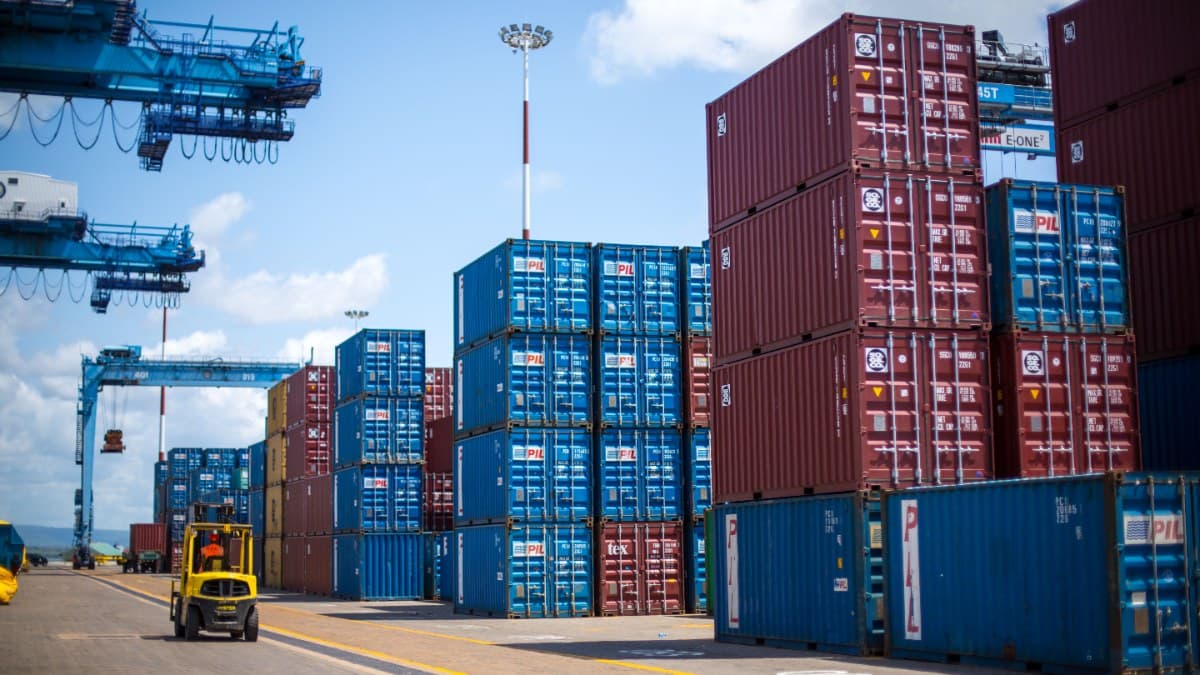
Container and air freight from Turkey to Uganda: Mombasa/Dar es Salaam corridors, PVoC documents, a landed-cost simulation and how to get a quote.
Last updated: 2 November 2026
How do you ship from Turkey to Uganda?
Uganda is landlocked, so ocean freight from Turkey to Uganda normally goes to Mombasa (Kenya) or Dar es Salaam (Tanzania) and then continues to Kampala by road (or rail plus road on the Kenyan side). Urgent or low-volume cargo can go by air from Istanbul to Entebbe. Price depends on commodity, weight/volume, container type, Incoterm, transit corridor and customs. This guide covers the options, cost logic, Uganda's import documents and a landed-cost example, and shows how to get a quote from Dexpell.
Want a quick first assessment with your cargo details? Start on Dexpell.ai Chat for your Turkey–Uganda shipment.
Which shipping options are realistic?
Ocean FCL (20' / 40'). Containers from Mersin, İskenderun, Ambarlı or Gemlik usually move via Mediterranean or Red Sea/Gulf transshipment hubs to Mombasa or Dar es Salaam. The line, sailing frequency and number of transshipments drive transit time.
LCL. Cargo that does not fill a container can be consolidated, but Uganda-bound LCL may take longer because of extra transshipment and warehouse handling.
Air freight. Samples, spare parts, electronics, medical items and urgent cargo can be booked from Istanbul to Entebbe (EBB), direct or with connections. For bulky cargo, volumetric weight (divisor 6000) often sets the charge.
Door-to-door. Dexpell coordinates pickup in Turkey, export clearance, the main leg and the road leg from Mombasa/Dar es Salaam to Kampala in one flow. Our Turkey to Kenya and Turkey to Tanzania guides cover the gateway ports used for Uganda cargo.
Mombasa or Dar es Salaam?
The Mombasa–Kampala route (Northern Corridor) is Uganda's main import path, while Dar es Salaam offers an alternative via the Central Corridor. The better choice depends on the shipping line, port congestion, EAC transit procedures, container free-time and final delivery point. Confirm the corridor together with your cargo details.
What determines the freight cost?
Origin port/city, container type and weight, commodity (dangerous goods, temperature control), Incoterm (EXW, FOB, CIF, DAP, DDP), corridor, port and terminal charges, transit bond, inland haulage, insurance and seasonal surcharges. Rates move often, so we do not publish a fixed price.
Market average (not a Dexpell price): general 2026 market guides put standard commercial air freight at roughly USD 2.50–8.00 per kg (source: Suaid Global, "Air Freight Cost per Kg 2026", updated 31 October 2026). This is not specific to the Turkey–Uganda lane. We could not find a reliable, current, sourced 20'/40' container average for Turkey–Mombasa/Dar es Salaam, so we do not guess one — the current rate depends on cargo, origin port and line availability and is confirmed in a quote.
Worked Cost Simulation
1) Chargeable weight example
Take 3 cartons of 60 × 50 × 40 cm (120,000 cm³ each) with a total actual weight of 45 kg. Total volume is 360,000 cm³. For air freight (divisor 6000): 360,000 ÷ 6000 = 60 kg volumetric weight, higher than 45 kg actual, so chargeable weight is 60 kg. For courier/express (divisor 5000): 360,000 ÷ 5000 = 72 kg. The same cartons are billed on different weights by service. Dexpell has not published a fixed courier rate for Uganda.
2) Uganda landed-cost example
Assumption: finished consumer goods (25% duty band), CIF value USD 10,000. Under the EAC common external tariff structure, finished consumer goods carry 25% duty (PwC Uganda Tax Data Card 2025/26). Calculation: import duty USD 2,500; import declaration fee (1%) USD 100; infrastructure levy (1.5%) USD 150; VAT 18% on CIF plus duty (USD 12,500) = USD 2,250; withholding tax 6% on CIF = USD 600 (generally creditable). Total about USD 5,600 of import charges on top of the CIF value. In addition, the PVoC conformity fee is roughly 0.25–0.50% of declared FOB (min. USD 235, max. USD 3,000), paid by the exporter. Industrial machinery, spares and raw materials may carry 0% or 10% duty or be exempt; actual amounts depend on the HS code. Sources: PwC Uganda Tax Data Card 2025/26; Business Times Uganda on the External Trade (Amendment) Act effective 1 July 2025; Bureau Veritas Uganda PVoC datasheet.
To run this simulation with your own weights, dimensions and product, use Dexpell.ai Chat for your Uganda shipment. For an exact price use Dexpell.ai.
Transit time
Port-to-port time depends on origin port, line and transshipments. Add customs/transit handling at Mombasa or Dar es Salaam and the road leg to Kampala. We do not quote a fixed number of days; the door-to-door schedule is set by the vessel, document readiness and the corridor. Air freight is measured in days, but connections and Entebbe clearance matter. Common delay causes: missing PVoC documents, port congestion, border crossings and wrong HS codes.
Uganda import rules: PVoC and required documents
Uganda applies Pre-Export Verification of Conformity (PVoC) to general goods: toys, electrical and electronics, automotive, chemicals/cosmetics, textiles, leather and plastics, furniture, paper, PPE and food are among the covered groups. The result is a Certificate of Conformity (CoC) or a Non-Conformity Report (NCR). The application needs a proforma or final invoice (with the importer's TIN), packing list, transport document, test reports from a suitable laboratory and a product declaration form (source: Bureau Veritas Uganda PVoC datasheet). Consignments of USD 2,000 FOB or less, and certain items such as industrial machinery and spares or raw materials, may be exempt, sometimes with an exemption letter from UNBS. Used tyres are prohibited. Always confirm the current rules with UNBS or the verification body before shipping.
Standard documents: commercial invoice, packing list, bill of lading (B/L) or air waybill (AWB), export declaration, certificate of origin where required, and product-specific certificates.
What is shipped from Turkey to Uganda?
Machinery and spare parts, building materials (ceramics, tiles, pipes and profiles), furniture, textiles and apparel, food and packaging, household appliances and automotive parts are the commercially relevant groups. Project cargo and heavy or out-of-gauge loads need separate route and permit planning.
How does Dexpell handle this route?
As an IATA cargo agent in Turkey, Dexpell works with airline tariffs for air capacity. On the ocean side we handle FCL/LCL booking, pickup and loading, export customs coordination, transit and road haulage via destination agents, cargo insurance and shipment tracking. See also our Ethiopia and Djibouti guides for neighboring markets.
Get a Turkey–Uganda Freight Quote
For a current Turkey–Uganda freight estimate, have ready your origin city, destination (Kampala or other), commodity, gross weight, dimensions, container type and Incoterm, then request your quote now or compare air and ocean options on Dexpell.ai Chat.
Prefer email? You can also send your shipment request directly to info@dexpell.com.
Frequently asked questions
How is container shipping from Turkey to Uganda done?
Because Uganda has no coastline, containers usually sail to Mombasa or Dar es Salaam and continue under transit to Kampala by road. The route and timing are confirmed against your cargo details.
How long does shipping from Turkey to Uganda take?
It depends on the shipping line, transshipments, port and transit procedures and the road leg. For a shipment-specific schedule, request a quote rather than relying on a generic number.
Is air freight to Uganda available?
Yes. Air freight from Istanbul to Entebbe can be arranged, and for bulky cargo volumetric weight (divisor 6000) often determines the charge.
Is a PVoC certificate mandatory?
For covered general goods, yes, with exemptions such as consignments up to USD 2,000 FOB. Check the current scope before shipping.
What import taxes apply in Uganda?
Depending on the product: 0%, 10%, 25% or 35% duty, 18% VAT, 1% import declaration fee, 1.5% infrastructure levy and 6% withholding tax (PwC Uganda Tax Data Card 2025/26). The exact amount depends on the HS code.
Can machinery be shipped from Turkey to Uganda?
Yes. Industrial machinery and spares may benefit from certain PVoC and duty relief; FCL, open-top or project cargo is planned according to size.
Does Dexpell offer door-to-door delivery?
Yes, from pickup in Turkey through export clearance, the main leg and destination coordination in one flow.
How do I get a price?
Share your cargo details via the Dexpell quote form or Dexpell.ai Chat and you will get a current, shipment-specific price.
Related articles
Turkey to Kenya shipping · Turkey to Tanzania shipping · Turkey to Ethiopia shipping · Turkey to Mozambique shipping

By
Dexpell LogisticsInternational Logistics & Trade
Dexpell Logistics is an international freight forwarding company offering sea, air and road transport, project logistics and trade consulting across 90+ countries. The news, guides and analyses on this blog are produced by the Dexpell expert team.
Dexpell is here for your logistics needs
Sea, air, and road freight, project logistics, and trade consulting across 90+ countries.
