
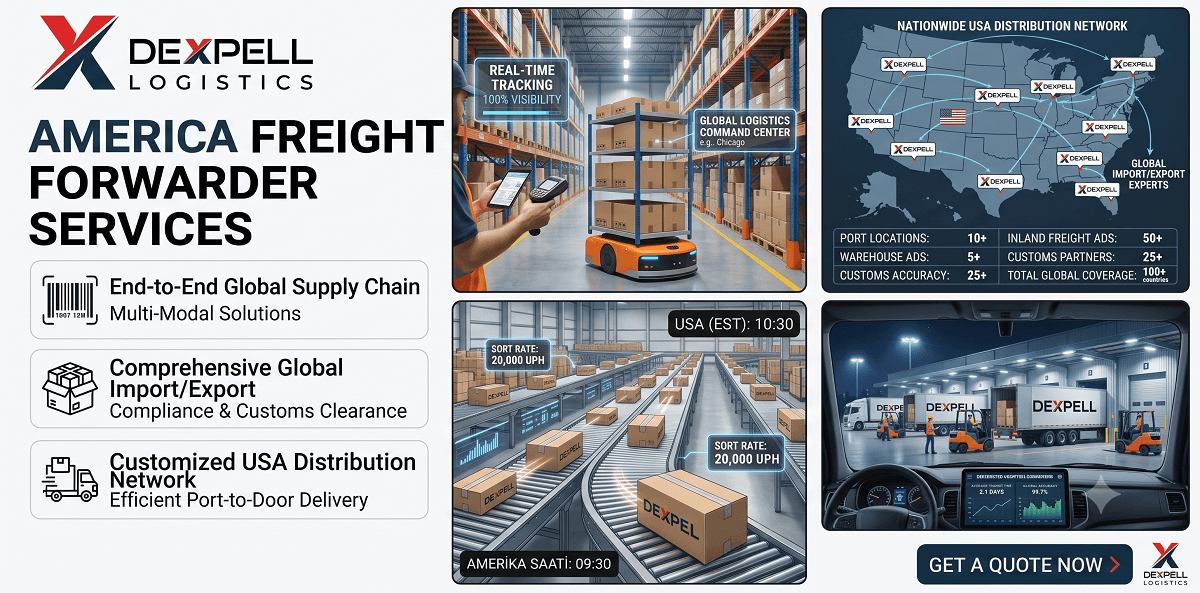
Looking for a reliable USA freight forwarder? Discover how Dexpell Logistics optimizes your transatlantic supply chain with AI-powered rates and 3PL services.
1. What Does a USA Freight Forwarder Do?
A USA freight forwarder acts as an intermediary between shippers and various transportation services to coordinate the movement of goods from international origins to the United States. Handling complex customs regulations, arranging ocean or air transit, and organizing last-mile deliveries are central to this role. Partnering with an experienced freight forwarder ensures that your import logistics and export logistics processes remain compliant, cost-effective, and on schedule.
2. Comparing Air Freight and Ocean Freight to the United States
Selecting the right mode of transport determines both your transit time and your overall freight cost. Shippers must weigh urgency against budgetary limits to maintain an efficient supply chain.
Shipping MethodAverage Transit TimePricing StructureBest Suited ForRisk LevelAir Freight3 - 5 Business DaysPer kilogram / chargeable weightHigh-value, lightweight, or urgent goodsLow (highly secure)Ocean Freight (FCL)22 - 35 DaysPer container (20ft, 40ft, 40ft HC)Heavy machinery, bulky items, volume cargoMedium (susceptible to port delays)Ocean Freight (LCL)25 - 40 DaysPer cubic meter (CBM)Mid-sized shipments that don't fill a containerMedium (requires consolidation)
3. Key Cost Factors in Transatlantic Shipping
To accurately calculate your total freight cost, look beyond base ocean or air transport rates. Several auxiliary variables shape your final invoice:
Volumetric (Dimensional) Weight
Air carriers charge based on either actual weight or dimensional weight, whichever is higher. The standard formula is (Length x Width x Height in cm) / 5000. If you ship oversized but lightweight packaging, you will pay for the volume space rather than the physical mass.
Surcharges and Peak Seasons
Transatlantic shipping lines apply fuel adjustments (BAF) and currency factors (CAF). During the peak shipping season (typically August through November), shipping lines frequently apply Peak Season Surcharges (PSS), which can increase baseline ocean freight rates significantly.
4. Navigating Customs and Compliance Risks in the US
The U.S. Customs and Border Protection (CBP) enforces some of the strictest import security protocols globally. Failing to adhere to these rules can halt your supply chain entirely.
ISF 10+2 Violations: For ocean shipments, the Importer Security Filing (ISF) must be submitted electronically at least 24 hours before the vessel departs the port of origin. Failing to meet this window results in immediate $5,000 CBP penalties and mandatory cargo holds.
Customs Bond Requirements: Every commercial entry into the US requires a Customs Bond. Shippers can purchase a Single Entry Bond or a Continuous Bond (valid for 12 months). Operating without an active bond means your cargo cannot be cleared or released.
Expert Advice: Do not rely on generic templates for commercial invoices and packing lists. Make sure your USA freight forwarder validates your Harmonized Tariff Schedule (HTSUS) codes prior to vessel departure to eliminate costly customs delays.
5. Dexpell Logistics: Your Digital USA Freight Forwarding Partner
Managing long-distance shipping shouldn't mean drowning in paperwork. Dexpell Logistics leverages advanced technology to make transatlantic shipping straightforward and highly predictable.
AI-Powered Freight Pricing: Get instant access to competitive ocean and air rates through Dexpell.ai. Our smart platform compares rates from global carriers to find the most efficient routing in seconds.
Real-Time Shipment Tracking: Never lose sight of your goods. Our digital dashboard offers real-time cargo tracking, keeping you updated as your container crosses the ocean or arrives at the airport.
End-to-End Customs & Warehousing: With dedicated offices in Saddle Brook, New Jersey and Istanbul, we coordinate customs brokerage, handle ISF filings, and arrange secure warehousing or Amazon FBA prep under one unified service.
6. Frequently Asked Questions (FAQ)
What is the difference between FCL and LCL shipping to the US?
FCL (Full Container Load) means you rent an entire 20ft or 40ft container for your goods only. LCL (Less than Container Load) means your goods share container space with other shippers, which is much cheaper for smaller volumes.
Do I need a US-based company to import goods using a USA freight forwarder?
No. Non-resident companies can act as the Foreign Importer of Record (Foreign IOR). A qualified freight forwarder can help you set up a Customs Bond and handle clearance without requiring a physical US entity.
How is the ocean freight transit time calculated to the United States?
Transit times depend on the coast of arrival. Shipments from Europe or Turkey to the East Coast (New York, Savannah) take 20 to 28 days, whereas reaching the West Coast (Los Angeles, Oakland) takes 35 to 45 days.
Simplify Your Transatlantic Shipping Today!
Don't let shipping delays and unexpected fees disrupt your business. Contact Dexpell.ai to get instant quotes, secure your Customs Bond, and experience a seamless digital freight forwarding journey to the United States.

By
Ersin TurgutVice President — US Customs & Trade
Ersin Turgut is Vice President at Dexpell Logistics, working across U.S. customs regulations, import processes, international logistics and foreign-trade compliance. In his articles he interprets current developments in U.S. trade in a clear, actionable way.
Dexpell is here for your logistics needs
Sea, air, and road freight, project logistics, and trade consulting across 90+ countries.
