
Courier and express shipping from Turkey to Switzerland: courier vs air freight, price and transit drivers, 8.1% import VAT, zero industrial duty, the CHF 5 rule, samples, commercial goods and documents.
How to Ship Courier and Express Parcels from Turkey to Switzerland
The most practical way to ship from Turkey to Switzerland is a door-to-door international courier (express) service: your shipment is collected in Istanbul, flown to Zurich (ZRH), Geneva (GVA) or Basel (BSL), cleared through Swiss import customs and delivered to the consignee in Zurich, Geneva, Basel, Bern or Lausanne. Because Switzerland is not an EU member, every shipment goes through a customs declaration; but since Switzerland abolished customs duties on industrial goods in 2024, for most shipments the process comes down to import VAT and a clearance fee. This guide covers which shipment types move to Switzerland and how, what drives price and transit time, Swiss customs rules, and what to watch for when sending samples, commercial goods and documents.
If you already know the weight, dimensions and destination city, you can get the right service and a realistic transit range for Switzerland in a few minutes via Dexpell.ai Chat: https://www.dexpell.ai/chat?utm_source=organic&utm_medium=blog&utm_campaign=switzerland_courier
What Can Be Shipped from Turkey to Switzerland?
Shipments from Turkey to Switzerland fall mainly into four groups: commercial samples (textiles and apparel, footwear, home textiles, furniture and lighting components, packaging), small commercial consignments (e-commerce orders, spare parts, machine components, watch and jewellery sub-components), documents (bank and insurance correspondence, contracts, tender files, notarised papers) and personal parcels sent to the Turkish community in Switzerland. The free trade agreement between Turkey and the EFTA states applies to Switzerland; however, since 1 January 2024 Switzerland has abolished customs duties on all industrial goods (Harmonized System chapters 25 to 97) regardless of origin, so for most courier shipments proof of origin only matters for agricultural products and food.
Courier or Air Freight?
Courier (express) is designed for documents, samples, small parcels, spare parts, urgent shipments, e-commerce orders and small commercial consignments. Collection, flight, Swiss import clearance and delivery run under a single transport document. Air freight suits palletised cargo, high gross weight, large volume and regular commercial flows; it is structured airport-to-airport, door-to-airport or door-to-door, with Swiss import clearance handled as a separate step.
A practical rule of thumb: a few cartons and a few dozen kilos in total means courier; hundreds of kilos, pallets or pieces over about 120 cm in a single shipment means air freight is both cheaper and more controllable. The cargo terminals at Zurich and Geneva handle both. If you are not sure, describe the dimensions, weight, product and route in Dexpell.ai Chat and the shipment will be routed to the right service.
What Determines Transit Time?
Three factors set transit time on the Turkey–Switzerland lane: the flight connection, Swiss customs clearance and the delivery address. Turkish Airlines operates direct scheduled flights from Istanbul to Zurich, Geneva and Basel; the Zurich and Geneva routes run several times a day, and the belly capacity on these flights is used for courier and air freight. Flight time is roughly three and a half hours, so the real determinant is not the flight but customs and distribution.
Swiss customs (the Federal Office for Customs and Border Security, FOCBS/BAZG) works on electronic declarations; with a complete commercial invoice and goods outside restricted categories, clearance is usually completed the same day the flight lands. A missing value declaration, a vague goods description, food or agricultural products requiring additional permits, and an unreachable consignee are the most common causes of delay. Remote addresses in the mountain cantons and the November–December peak can add days. Ask for a realistic range specific to your shipment rather than a fixed date.
How Is the Price Calculated?
Courier and air freight rates to Switzerland are calculated on chargeable weight, the greater of actual and volumetric weight. Volumetric weight for courier is typically length x width x height (cm) / 5000 and /6000 for air freight; a light but bulky carton is charged at more than its actual kilos. Other price components: collection city and destination zone (central Zurich and a village in Graubünden are not priced the same), service level (next-day, economy express, air freight), fuel surcharge, security screening fee, restricted or dangerous goods surcharges, the Swiss import declaration fee (carriers in Switzerland charge a separate clearance service fee), the fee for VAT advanced on behalf of the consignee, and cargo insurance if requested.
This page does not show a fixed price list because two shipments on the same lane can differ substantially in cost depending on product, dimensions and delivery terms. For pricing and transit specific to your consignment, share the dimensions and destination city in Dexpell.ai Chat: https://www.dexpell.ai/chat?utm_source=organic&utm_medium=blog&utm_campaign=switzerland_courier
Swiss Customs Rules
Switzerland is outside the EU customs territory and applies its own rules. The essentials: the standard import VAT rate has been 8.1 percent since 2024 (a reduced rate of 2.6 percent applies to food, books and medicines, among others) and is calculated on the value of the goods plus transport costs. If the VAT amount calculated does not exceed CHF 5 it is not collected; at 8.1 percent that corresponds to a taxable base of roughly CHF 62, and where no VAT is collected the carrier's clearance fee usually does not apply either. Since 1 January 2024 customs duty on industrial goods is zero; agricultural products and food remain subject to duty assessed on gross weight, and for these an EUR.1 movement certificate or an origin declaration on the invoice can be used to claim preferential treatment under the EFTA–Turkey agreement. Gifts sent between private individuals are relieved up to CHF 100, excluding tobacco and alcohol. Alcohol, tobacco and certain other goods are also subject to excise duty.
Switzerland forms a common customs security area with the EU and Norway, so air cargo and courier shipments to Switzerland also require a pre-arrival entry summary declaration (ENS) under ICS2 with a specific goods description. You can read how ICS2 works at https://www.dexpell.com/en/media/blog/ics2. Rates and thresholds change, so confirm the rules applicable on your shipping date via Dexpell.ai Chat.
Sample Shipments
Swiss customs requires a realistic value declaration on every consignment; shipments marked "no commercial value" with a zero value are pulled for inspection and delayed. The correct practice is to state "Sample – not for resale, value for customs purposes only" on the invoice and declare a realistic unit value. Since customs duty on industrial samples is already zero, VAT is the only cost, and for low-value samples the CHF 5 rule can mean no VAT is collected at all. Textile samples should state fibre composition and quantity; other products should state material and intended use. Food samples count as agricultural products and may require additional documents and controls.
Commercial Shipments and the Commercial Invoice
For commercial shipments to Switzerland you need a complete commercial invoice (shipper and consignee names, addresses, the consignee's Swiss UID/VAT number, product description, HS code, quantity, unit price, total value, country of origin, Incoterms), a packing list and, for agricultural products and food, an EUR.1 movement certificate or an origin declaration on the invoice to claim preferential duty. For industrial goods proof of origin is not mandatory because duty is zero, but the goods description and HS code are still needed to determine the VAT rate and any restrictions. On the Turkish side, shipments up to 300 kg and EUR 15,000 can be declared under the micro-export regime (ETGB), which speeds up the process and supports VAT refunds for e-exporters. A VAT-registered Swiss consignee can generally recover import VAT under the normal rules.
Document Shipments
Documents with no commercial value (contracts, bank and insurance correspondence, tender files, original invoices, notarised papers, diplomas) ship to Switzerland under document status and attract neither duty nor VAT. Putting a sample, USB stick, card or promotional item into a document envelope turns it into a parcel that requires a declaration. For documents addressed to international organisations in Geneva or corporate headquarters in Zurich and Basel, include the recipient's full name and internal department to speed up delivery.
Prohibited and Restricted Items
Items that cannot be sent to Switzerland by courier include firearms and parts, narcotics and psychotropic substances, counterfeit goods (Switzerland is particularly strict on counterfeit watches and luxury goods), products of species protected under CITES and hazardous materials. Restricted categories include meat, dairy and plant products, which are subject to veterinary and phytosanitary controls and in practice cannot move by courier; medicines and medical products, which fall under Swissmedic rules; and tobacco and alcohol, which are subject to excise duty and quantity limits. Devices with lithium batteries, aerosols and perfume require dangerous goods packaging and labelling for air transport. If you are unsure whether your product falls into one of these categories, ask in Dexpell.ai Chat before shipping.
What Information Is Needed to Ship from Turkey?
To quote and plan a Swiss shipment, the following is enough: collection city and postcode, destination city and Swiss postcode (four digits), number of pieces, length, width and height of each piece, gross weight, product description and HS code if known, declared value and currency, ready date, and whether the consignee is a company or a private individual. For commercial shipments, confirming the consignee's UID number and the delivery terms (DAP or DDP) in advance avoids losing a day at customs.
How to Get Started with Dexpell.ai
Dexpell operates as an IATA cargo agent in Turkey, which gives it direct access to airline capacity and lets the same team plan both courier and air freight on the Switzerland lane. The process: you describe your shipment in Dexpell.ai Chat, the system classifies it as courier or air freight and prepares a quote, collection is scheduled after approval, the commercial invoice and any origin document are checked, the shipment departs Istanbul by air, and Swiss import clearance and delivery are tracked through to the consignee. The general scope of the courier and express service is described at https://www.dexpell.com/en/services/courier-express.
Get a Quote for Your Switzerland Shipment Now
To send samples, commercial goods or documents to Switzerland, open Dexpell.ai Chat and have the following ready: collection city and postcode, destination city and postcode, number of pieces, dimensions, gross weight, product description, declared value and ready date. With this information you will receive a service recommendation, a transit range and a quote for Switzerland within minutes: https://www.dexpell.ai/chat?utm_source=organic&utm_medium=blog&utm_campaign=switzerland_courier
Frequently Asked Questions
How long does courier shipping from Turkey to Switzerland take?
With direct flights from Istanbul to Zurich, Geneva and Basel, express shipments are usually delivered within a few business days, and documents and small parcels are the fastest group. Customs inspection, missing paperwork, remote addresses and peak periods can extend this, so the exact timeline is confirmed per shipment.
Is there customs duty on goods sent to Switzerland?
Since 1 January 2024 Switzerland has abolished customs duty on industrial goods regardless of origin; these goods attract only 8.1 percent import VAT and the carrier's clearance fee. Agricultural products and food remain dutiable.
What is the CHF 5 rule?
If the import VAT calculated on a consignment does not exceed CHF 5 it is not collected; at 8.1 percent that corresponds to a taxable base of roughly CHF 62. In that case the carrier's clearance fee usually does not apply either, so low-value samples can be delivered without additional cost.
Do I pay tax when sending a gift to Switzerland?
Gifts sent between private individuals are relieved up to CHF 100. Above that value VAT applies; tobacco and alcohol are excluded from the relief and subject to quantity limits.
Is an A.TR certificate required for Switzerland?
No. A.TR applies only to the Turkey–EU Customs Union and Switzerland is not an EU member. For agricultural products and food shipped to Switzerland, an EUR.1 or an origin declaration on the invoice is used under the EFTA–Turkey agreement; for industrial goods duty is already zero, so proof of origin is not mandatory.
Which items cannot be sent to Switzerland?
Weapons and parts, narcotics, counterfeit goods, CITES-protected species and hazardous materials are prohibited. Meat, dairy and plant products and medicines are heavily restricted, and lithium batteries, aerosols and perfume require special packaging.
Which documents are required for a commercial shipment?
A complete commercial invoice, a packing list and, for agricultural products and food, an EUR.1 or origin declaration to claim preferential duty. A pre-arrival ENS under ICS2 is also filed for shipments to Switzerland, and Dexpell prepares it.
Should I choose courier or air freight?
A few cartons, low total weight and an urgent deadline point to courier; pallets, hundreds of kilos or large volume point to air freight. If you cannot decide, describe the dimensions, weight and product in Dexpell.ai Chat and we will recommend the right service.
Related Services and Articles
Courier and express service: https://www.dexpell.com/en/services/courier-express
Turkey to Germany courier and express shipping: https://www.dexpell.com/en/media/blog/turkey-to-germany-courier-express-shipping
Turkey to France courier and express shipping: https://www.dexpell.com/en/media/blog/turkey-to-france-courier-express-shipping
Turkey to Austria courier and express shipping: https://www.dexpell.com/en/media/blog/turkey-to-austria-courier-express-shipping
EU Import Control System ICS2: https://www.dexpell.com/en/media/blog/ics2
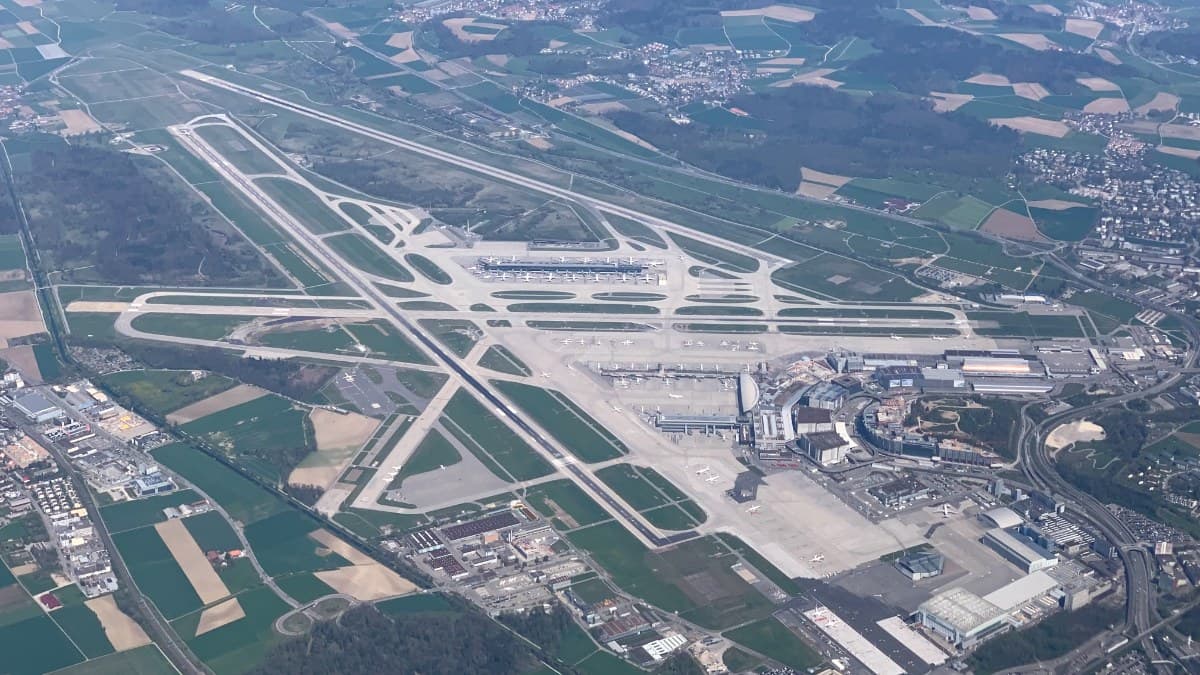
Cover photo: Aerial view of Zurich Airport – Henry Töpel, Wikimedia Commons, CC BY-SA 4.0.

By
Dexpell LogisticsInternational Logistics & Trade
Dexpell Logistics is an international freight forwarding company offering sea, air and road transport, project logistics and trade consulting across 90+ countries. The news, guides and analyses on this blog are produced by the Dexpell expert team.
Dexpell is here for your logistics needs
Sea, air, and road freight, project logistics, and trade consulting across 90+ countries.
