
Shipping from Turkey to Tunisia explained for exporters: FCL/LCL ocean freight, air freight and door-to-door options, what drives freight cost, transit-time logic, the Radès, Sfax and Sousse gateways, Tunisia's exceptional duties on certain Turkish goods and the documents you need. Request a current Turkey–Tunisia freight quote from Dexpell.
Last Updated: October 11, 2026
How Does Shipping from Turkey to Tunisia Work, and What Determines the Cost?
Export cargo from Turkey to Tunisia moves in three practical ways: ocean freight as FCL (full container) or LCL (groupage), air freight, and door-to-door combinations of both. The main gateway is the Port of Radès, about 12 km south of Tunis; the ports of Sfax and Sousse and Tunis-Carthage Airport are the other key entry points. Your freight cost depends on the pickup city, container type or chargeable weight, commodity, Incoterm, destination port and the customs and delivery services you need in Tunisia. This guide explains each cost driver, how transit time really works on this route, Tunisia's special duty measures on certain Turkish-origin goods and the documents you need — and how to get a current quote for your shipment.
Which Shipping Options Are Available from Turkey to Tunisia?
FCL Container Shipping (20' / 40' / 40' HC)
For bulky export cargo such as textile raw materials, fabrics and yarn, construction materials, iron and steel products, furniture and machinery, a full container is usually the most economical choice. Cargo typically leaves from Ambarlı/Istanbul, Gemlik, Izmir (Aliağa) or Mersin. Many Tunisia services connect through Mediterranean transshipment hubs such as Malta or Italian ports, so even a short-looking route can take different times depending on the transshipment plan. At Dexpell we work with all major container lines serving this trade, including CMA CGM, COSCO, Arkas, Medkon, Akkon, MSC and Maersk; the best line and port of loading for your cargo is selected together at the quotation stage.
LCL Groupage by Sea
If you cannot fill a container, your cargo is consolidated with other shipments at a CFS warehouse. LCL suits sample lots, spare parts, small textile orders and first trial exports. Charges are usually based on volume (m³) or weight, whichever is higher. Dexpell runs a regular weekly LCL service, so consolidated shipments can often secure a more competitive rate than a full container. Check our sailing schedule for current departures: https://www.dexpell.com/en/sailing-schedule
Air Freight from Istanbul to Tunis-Carthage
Air freight is the right fit for urgent spare parts, samples, high-value or time-sensitive goods. On the Istanbul–Tunis route, Turkish Airlines and Tunisair offer direct service, while Royal Jordanian, EgyptAir and Air Morocco provide connecting options. For shipments of 100 kg and above, average rates are about 2.00–2.50 USD per kg on direct services and 1.50–2.00 USD per kg on connecting services; the final rate depends on chargeable weight, commodity and season.
Door-to-Door, DAP and DDP
Pickup from your factory, export customs, international freight, Tunisian import clearance and delivery to the consignee can be handled under one responsibility. Under DAP, duties and taxes are paid by the buyer; DDP requires the Tunisian duty and customs process to be handled on the shipper's behalf and is assessed case by case depending on the product and consignee.
Not sure whether FCL, LCL or air freight fits your cargo best? Share the product, weight and dimensions at https://www.dexpell.com/en/quote to compare options side by side.
What Determines the Freight Cost from Turkey to Tunisia?
Freight rates change regularly with carrier capacity, fuel costs and season, so quoting a fixed price here would be misleading. These are the items that actually shape your quotation:
Pickup location: distance from the factory to the port and inland haulage (for example Bursa to Gemlik, or Gaziantep to Mersin).
Container type or volume: 20', 40', 40' HC; for LCL, cubic metres and weight.
Commodity: dangerous goods (IMO), temperature-controlled or project cargo add cost.
Incoterm: EXW, FCA, FOB, CFR/CIF, DAP or DDP decides who pays which charges.
Destination gateway: Radès, Sfax, Sousse or Bizerte — service and transshipment plans differ by port.
Port surcharges and waiting: THC, BAF/fuel surcharges and demurrage/detention risk during port congestion.
Tunisian duties and VAT: customs value is CIF-based; duties depend on the tariff classification of the product.
For air freight, the key factors are chargeable weight, the nature of the goods, airline fuel and security surcharges, airport handling and last-mile delivery.
Current Average Freight Costs from Turkey to Tunisia
The figures below reflect market averages for shipments from Turkish ports to Tunisia; the exact price varies by port of loading, carrier, season and cargo.
Sea Freight, Full Container (FCL)
Average ocean freight from Turkish ports to Tunisia is about 750 USD for a 20' DC container and about 1,100 USD for a 40' HC container. In addition, Turkish export local port charges are roughly 450–500 USD and vary depending on the port of loading.
Air Freight
For shipments of 100 kg and above, expect about 2.00–2.50 USD per kg with Turkish Airlines and Tunisair, and about 1.50–2.00 USD per kg on connecting services via Royal Jordanian, EgyptAir and Air Morocco.
Weekly LCL Service
Dexpell's regular weekly LCL service helps cargo that does not fill a container find a more economical rate. See our current departures on the sailing schedule: https://www.dexpell.com/en/sailing-schedule — and request a rate for your own cargo through our quote form: https://www.dexpell.com/en/quote
How Long Does Shipping from Turkey to Tunisia Take?
The sea distance between Turkey and Tunisia is short by Mediterranean standards, but real transit time depends on whether the service transships, the vessel cut-off day and congestion at the destination port. Port-to-port, door-to-door and airport-to-airport times should be assessed separately:
Port-to-port (ocean): varies by service rotation and transshipment hub; we confirm it against the current sailing schedule when quoting.
Door-to-door: the sum of pickup and export clearance in Turkey, vessel waiting time, import clearance in Tunisia and inland delivery.
Air freight: flight time is short, but acceptance, flight booking and Tunisian clearance determine the total.
Radès handles roughly 63% of Tunisia's container throughput, and the country's container volumes grew 9% in the first half of 2026. Because Radès can experience periodic vessel waiting and yard congestion, it is wise to build buffer time into your plan and agree free-time terms in advance. Sfax and Sousse can serve as alternative gateways for consignees in the south and along the Sahel coast.
To get the current sailing schedule and price for your own cargo, share your pickup and delivery cities and request a freight quote now at https://www.dexpell.com/en/quote.
Main Tunisian Ports, Airport and Delivery Regions
Radès (Tunis): the country's main container port, serving Greater Tunis, Ben Arous and the northern industrial zones.
Sfax: Tunisia's second-largest container port, serving southern industrial and trading hubs.
Sousse: close to the Sahel coast (Sousse, Monastir) and its textile and apparel manufacturers.
Bizerte: a smaller northern gateway whose volumes rose sharply in the first half of 2026.
Tunis-Carthage Airport (TUN): the main entry point for air cargo.
What Does Turkey Export to Tunisia?
According to Turkish Exporters Assembly (TİM) data, Turkey's exports to Tunisia were about USD 1.11 billion in 2024, and textiles and textile raw materials were one of the largest categories at roughly USD 230 million. Tunisia's apparel industry, which produces largely for European buyers, regularly sources Turkish fabrics, yarn and trims. Tunisian official statistics show imports from Turkey rose in the first half of 2025 compared with the same period a year earlier.
Shipping Textile Raw Materials and Fabrics to Tunisia
Fabric rolls and yarn cones usually move by FCL or LCL. Moisture- and crush-resistant packing, a per-roll weight list and correct HS classification all speed up clearance. Urgent samples and trims that must meet a factory's production schedule are typically sent by air.
Machinery, Spare Parts, Construction Materials and Furniture
Out-of-gauge machinery and equipment can be planned on flat rack or open top containers, while construction materials, ceramics and furniture usually travel by FCL. For heavy or oversized cargo, lifting points, lashing and equipment availability at the destination port should be checked in advance.
Tunisian Customs: Duties on Turkish Goods and Required Documents
Turkey and Tunisia have a Free Trade Agreement that entered into force in 2005. However, the parties revised it on December 3, 2023, and Tunisia's 2024 Finance Law introduced exceptional customs duties from January 1, 2024 on certain Turkish industrial products that have locally made equivalents. According to published reports, duties on these products rose from 0% to a range of 27–37.5% (about 75% of the standard MFN rate), with items such as detergents and cleaning products, tyres, ready-to-wear clothing and plastic articles on the list. Because the duration and phase-out schedule can differ by product, we recommend confirming the current rate for your HS code with your buyer's customs broker before shipping.
For commercial imports into Tunisia, customs value is determined on a CIF basis and the standard VAT (TVA) rate is 19%; additional taxes may apply depending on the product. Do not expect a general low-value exemption for commercial cargo. Commonly requested documents:
Commercial invoice (showing currency, unit price, quantity and HS code)
Detailed packing list
Bill of Lading (B/L) or Air Waybill (AWB)
Proof of origin: for preferential FTA treatment, typically an EUR.1 movement certificate; otherwise a certificate of origin
Turkish export declaration
Product-specific documents (conformity or analysis certificates for food, cosmetics, electrical goods, etc.)
In Tunisia, the consignee must be registered as an importer and the declaration is filed electronically through a licensed customs broker. Inconsistencies in documents can lead to delays and extra storage costs at Radès, so check the invoice and packing list before loading.
How Dexpell Handles Your Turkey–Tunisia Shipment
Dexpell manages pickup from industrial zones across Turkey, export customs coordination, FCL/LCL and air freight bookings, coordination with our agent and customs broker in Tunisia, and delivery to the consignee's address from a single point of contact. As an IATA cargo agent in Turkey, we work directly with airlines, which gives us an operational advantage when negotiating air cargo capacity and rates. On request, we add cargo insurance, equipment planning for out-of-gauge and project cargo, and shipment tracking throughout the journey.
Get Your Turkey–Tunisia Freight Quote
To receive a current Tunisia freight rate, share your pickup city, destination city or port, commodity, gross weight, dimensions or volume, container type (if applicable) and preferred Incoterm. Quote form: https://www.dexpell.com/en/quote
For current sailings and departure dates, visit our sailing schedule page: https://www.dexpell.com/en/sailing-schedule
You can also email your freight request to info@dexpell.com; please use the subject line "Tunisia Freight Request" and include your pickup city, commodity and weight/volume.
Frequently Asked Questions
How much does it cost to ship a container from Turkey to Tunisia?
Average ocean freight from Turkish ports to Tunisia is about 750 USD for a 20' DC and about 1,100 USD for a 40' HC, plus Turkish export local port charges of roughly 450–500 USD depending on the port of loading. The exact price depends on carrier, season and cargo, so request a quote for your shipment: https://www.dexpell.com/en/quote
How long does sea freight from Turkey to Tunisia take?
It depends on whether the service transships, the vessel cut-off day and congestion at Radès. For door-to-door planning, also factor in customs and inland transport time in both countries.
Are Turkish goods duty-free in Tunisia?
Although the two countries have a Free Trade Agreement, since 2024 Tunisia has applied exceptional duties to certain Turkish industrial products that have local equivalents. Confirm your product's status by HS code with your buyer's customs broker.
Can I send LCL (groupage) cargo to Tunisia?
Yes. If you cannot fill a container, your cargo can be consolidated and shipped as LCL. Charges are based on volume or weight, whichever is higher.
When does air freight to Tunisia make sense?
Air freight is preferred for urgent spare parts, samples, trims and high-value, low-volume goods. It is charged on the greater of actual and volumetric weight.
Which documents are needed to import into Tunisia?
Typically a commercial invoice, packing list, B/L or AWB and proof of origin. Additional conformity or analysis certificates may be required depending on the product.
Which Tunisian port should I use?
Radès usually suits Greater Tunis and the north, Sfax the southern industrial areas, and Sousse the textile manufacturers of the Sahel coast. The final choice depends on the sailing schedule and inland distance.
Can Dexpell deliver door-to-door in Tunisia?
Yes, door-to-door transport can be arranged from pickup in Turkey to the consignee's address in Tunisia. Who pays duties and taxes (DAP or DDP) is agreed at the quotation stage.
Related Services and Articles
Shipping from Turkey to Morocco: https://www.dexpell.com/en/media/blog/shipping-from-turkey-to-morocco
Shipping from Turkey to Algeria: https://www.dexpell.com/en/media/blog/shipping-from-turkey-to-algeria
Shipping from Turkey to Libya: https://www.dexpell.com/en/media/blog/shipping-from-turkey-to-libya
Shipping from Turkey to Egypt: https://www.dexpell.com/en/media/blog/shipping-from-turkey-to-egypt
Shipping from Turkey to Tanzania: https://www.dexpell.com/en/media/blog/shipping-from-turkey-to-tanzania
Importer of Record Services in Turkey: https://www.dexpell.com/en/media/blog/importer-of-record-ior-services-in-turkey-import-without-setting-up-your-own-com
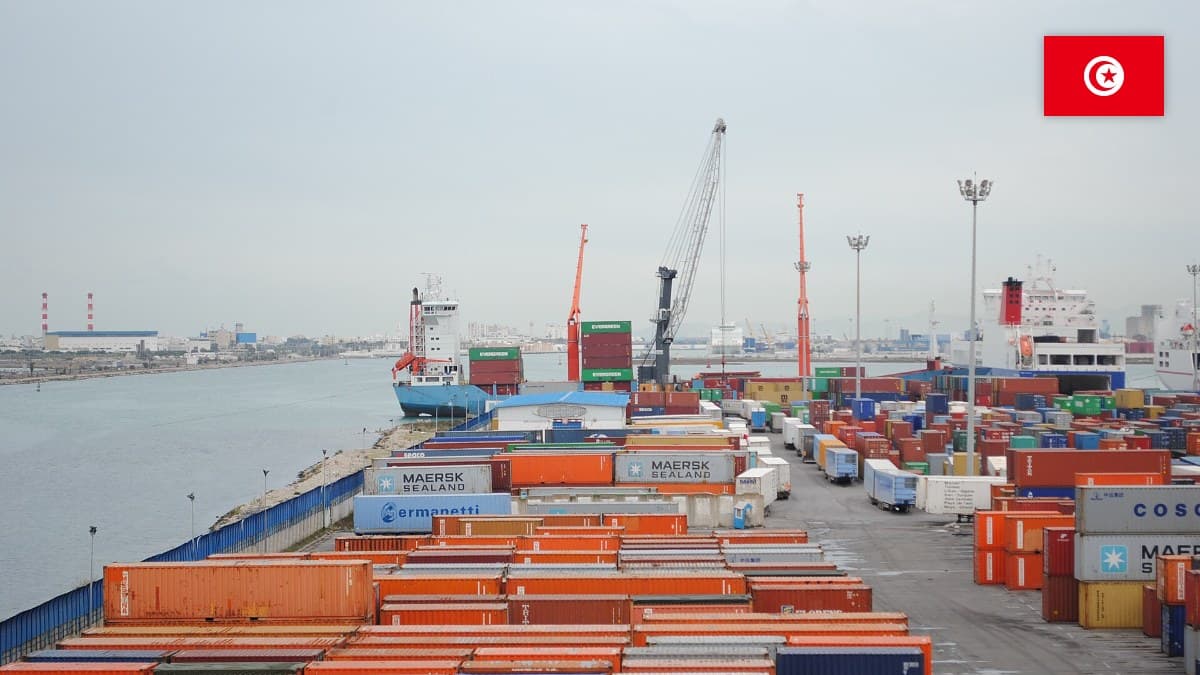
Cover image: "Port Rades 02" – M.Rais, Wikimedia Commons, CC BY-SA 3.0 (cropped, flag added).

By
Dexpell LogisticsInternational Logistics & Trade
Dexpell Logistics is an international freight forwarding company offering sea, air and road transport, project logistics and trade consulting across 90+ countries. The news, guides and analyses on this blog are produced by the Dexpell expert team.
Dexpell is here for your logistics needs
Sea, air, and road freight, project logistics, and trade consulting across 90+ countries.
